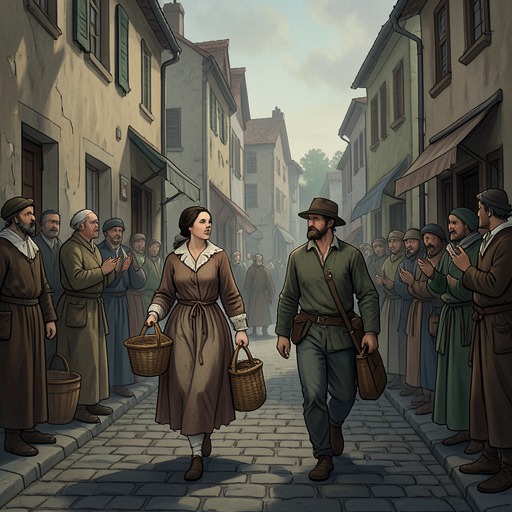
The “Merricat, said Constance” refrain
We Have Always Lived in the CastleThe “Merricat, said Constance” refrain is a recurring exchange between the sisters that changes meaning when villagers take it up during their attack on the Blackwood house. Its movement from an intimate domestic rhythm to public mockery, and then to a child’s uneasy imitation outside the ruined house, makes the refrain a measure of how the sisters’ private life is invaded, transformed, and eventually retold by the village.
From private exchange to public taunt
The refrain enters the attack while Merricat and Constance are outside the dining room’s tall windows. Amid the crowd’s laughter, someone begins the familiar call about tea, repeating it with a rhythmic insistence. The words evoke the sisters’ domestic routine at the moment that routine is being destroyed: dishes are smashing inside, and the villagers are closing in on the windows. The contrast is structural as well as emotional. A phrase associated with an ordinary offer of care is no longer safely contained within the sisters’ home; the crowd makes it audible as a taunt.
The repetition continues as Merricat urges Constance to run. Constance cannot move at first, and Merricat pulls her away just before a chair is thrown through the window. As they head for the steps, Constance covers her face with Uncle Julian’s shawl. The refrain sounds again, now altered from an invitation to tea into a question about going to sleep. Its changing domestic prompts accompany the breaking of the house’s familiar boundaries, while the sisters’ attempt to escape gives the repeated words an immediate, practical counterpoint: the crowd speaks in a ritualized chorus; Merricat tries to get Constance to safety.
The crowd’s appropriation of the sisters’ language
The refrain is not an isolated shout. As the sisters try to move through the crowd, villagers block their routes, and laughter, singing, shouting, and howling overlap. One of the recurring lines is answered by a villager politely repeating Merricat’s part, including her suspicion that she would be poisoned. That mimicry turns the sisters’ exchange into a performance staged by their persecutors. The intimate call-and-response survives, but its speakers and circumstances have been changed: the crowd uses the recognizable pattern to surround and unsettle the sisters.
The refrain’s variations sharpen that reversal. The appeal for tea recurs alongside the version about sleep, while the poisoning response is detached from its original exchange and repeated by someone else. Their order and frequency make the language feel less like conversation than a refrain imposed from outside. Merricat holds Constance’s hand and repeatedly tries to find a way through the circle; Constance keeps Uncle Julian’s shawl over her face. The contrast between the crowd’s repeated words and the sisters’ constrained movement gives the refrain its force without making it a simple symbol of their bond: what once belonged to their shared domestic world can now be used against them.
Repetition, fear, and retreat
During the attack, Merricat’s thought of being on the moon accompanies the refrain’s first return. The wish to be elsewhere stands against the concrete scene at the dining-room windows, where the crowd is close and the house’s contents are being smashed. As the sisters reach the steps, they hesitate under the headlights crossing the lawn. Their retreat to the woods is not immediate; they remain exposed near the house, and the refrain continues while the crowd blocks successive attempts to escape. Repetition thus binds the scene together: the sisters are trying to leave, while the chant keeps drawing their attention back to the home and the people gathered around it.
The attack also gives the refrain a public life that extends beyond that night. The sisters later learn that outsiders see the ruined, vine-covered structure from the path between the village and the highway, but cannot see them watching through the vines. Children warn one another away from the steps, imagining that the women inside might get them. The house is now both a visible ruin and a place from which the sisters remain unseen; the refrain helps carry the story of that separation into the village’s imagination.
A child repeats the refrain
That transformation becomes especially clear when a boy, dared by the others, stands at the foot of the steps. He shivers, nearly cries, and nearly runs before shakily repeating the tea version of the refrain. He then flees, followed by the other children. His recitation echoes the villagers’ earlier appropriation, but its circumstances differ: rather than joining an attacking crowd, he speaks from a distance, frightened of the house and of the women he has been warned about.
That night, a basket of fresh eggs is left on the doorsill with a note asking forgiveness for the boy’s behavior. Constance puts the eggs into a bowl for the cooler and supposes that the child is probably hiding under his bed; Merricat, in turn, suggests that he may have been punished for his manners. The small exchange does not erase the village’s hostility or the children’s fear, but it gives the repeated words a different aftermath. The refrain has passed from the sisters to a crowd and then to a child, while the eggs and apology create a quiet, domestic response at the threshold of the damaged house.
Narrative and thematic significance
The refrain’s significance rests on repetition with altered speakers and stakes. Its domestic cadence first signals familiarity; during the attack, the villagers’ imitation converts familiarity into exposure and ridicule; outside the ruined house, the boy’s uncertain repetition shows the phrase becoming part of local folklore. Each return recalls the sisters’ relationship while also recording how the village has taken possession of its outward signs. The refrain therefore connects private routine, public persecution, and the uneasy distance that remains between the sisters and their neighbors.